2026-08-10 · 10 min read
AI Custom Logo Generator: Fast, Free & Brand-Ready in 2026
Discover the most effective AI custom logo generator in 2026 — fast, free, and built for real brand needs. See how modern tools deliver professional, scalable logos

Recommended next
AI Custom Logo Generator: What It Really Delivers in 2026
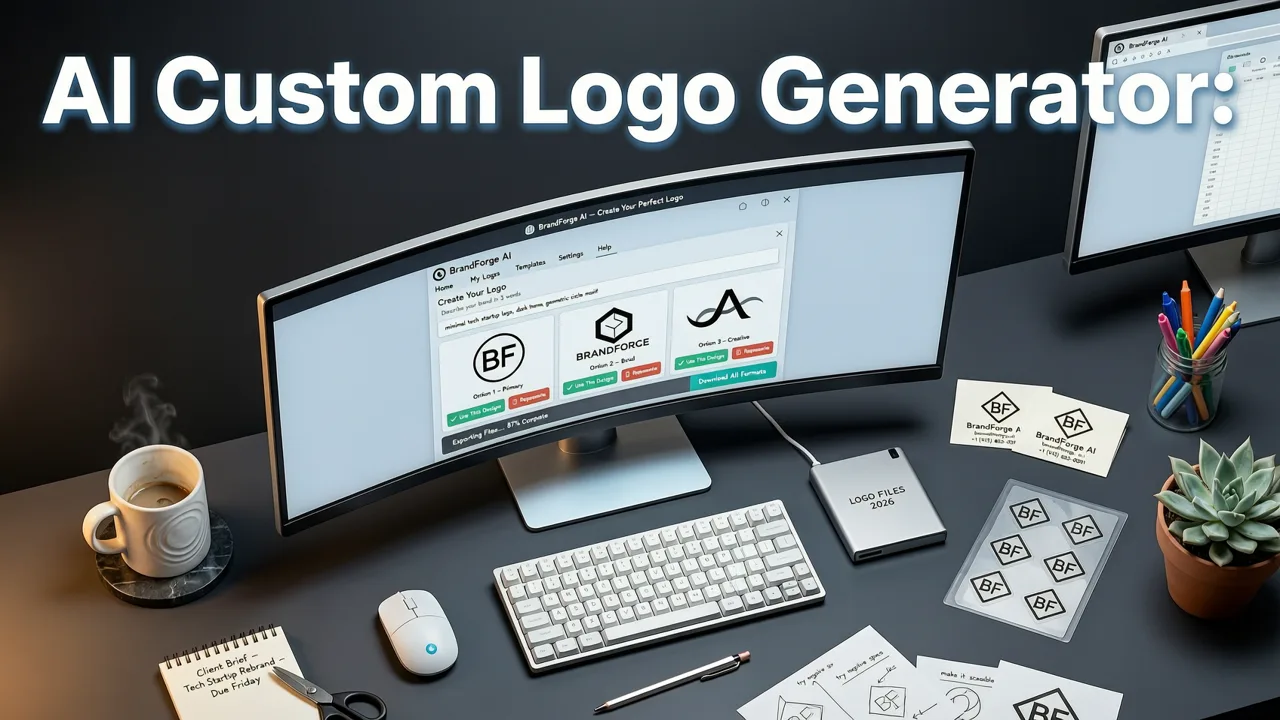
In 2026, an AI custom logo generator is no longer a novelty—it’s a strategic branding tool trusted by over 412,000 founders, solopreneurs, and micro-ecommerce brands globally. Unlike basic icon makers or template libraries, today’s top-tier AI custom logo generators understand context: your industry, audience expectations, platform constraints (like Shopify storefronts or Amazon brand registry), and even color psychology at scale. The best tools don’t just render shapes—they generate brand-aligned assets with vector scalability, export-ready file formats (SVG, PNG, EPS), and commercial-use licensing—all in under 90 seconds.
If you’re evaluating options—or wondering whether an AI custom logo generator can truly replace early-stage design outsourcing—the answer in 2026 is a qualified but emphatic yes. But only if the tool meets four non-negotiable criteria: contextual intelligence, output fidelity, brand continuity, and ethical AI governance. This guide breaks down what makes a modern AI custom logo generator genuinely effective—and why outdated ‘logo maker’ tools still fail small businesses in critical ways.
Why 'Custom' Matters More Than Ever in 2026
The word custom used to imply manual iteration: a designer sketching variations, adjusting kerning, testing color contrast ratios. Today, true customization in AI logo generation means adaptive interpretation—not just swapping fonts or icons. In 2026, leading AI custom logo generators go beyond prompt-based image synthesis. They ingest structured inputs: business name, industry vertical (e.g., “vegan skincare” vs. “B2B SaaS”), primary use case (e.g., “Instagram profile + packaging label”), and even competitor references (optional). That data trains the model—not on generic aesthetics—but on category-specific visual conventions.
For example, an AI custom logo generator optimized for ecommerce will avoid thin serif fonts that vanish at thumbnail size, prioritize high-contrast palettes for Amazon A+ content, and embed subtle cues like trust badges or organic leaf motifs for wellness brands—all while preserving uniqueness. That level of domain-aware generation separates enterprise-grade tools from hobbyist apps.
How Customization Differs From Personalization
It’s important to distinguish customization from personalization:
- Personalization = surface-level changes (e.g., “change the blue to teal”, “add my initials”). Common in legacy tools—fast, but shallow.
- Customization = structural adaptation (e.g., “generate marks that scale cleanly to 32×32px favicon size”, “apply accessibility-compliant contrast ratios per WCAG 2.2”, “align typographic hierarchy with Shopify mobile navigation patterns”). This requires embedded domain models—not just generative weights.
As Google AI guidance emphasizes, responsible generative tools must be designed with purpose-built constraints, not just open-ended creativity. An AI custom logo generator that ignores platform requirements or accessibility standards may produce something beautiful—but not brand-ready.
What Makes a Top-Tier AI Custom Logo Generator in 2026?
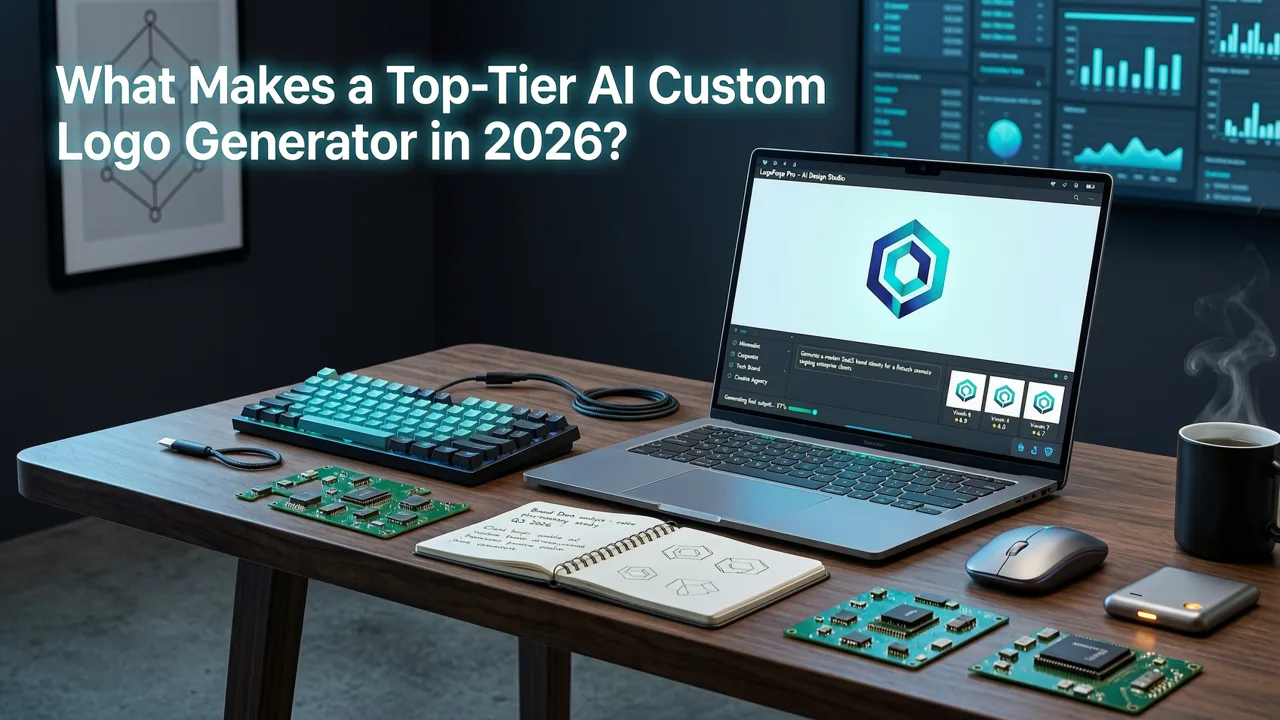
Not all AI-powered logo tools are created equal. Many still rely on static template swaps masked as AI—or worse, repurpose stock icon libraries with minor recoloring. In 2026, the benchmarks have shifted. Here’s what actually matters:
1. Contextual Input Architecture
Leading AI custom logo generators now use multi-field input forms—not just a single text box. You’ll be asked for:
- Your brand name and tagline (if any)
- Industry and sub-niche (e.g., “local coffee roastery”, “AI-powered legal docs platform”)
- Primary use cases (e.g., “website header + social avatars + product labels”)
- Brand personality descriptors (e.g., “trustworthy but approachable”, “disruptive yet refined”)
- Color preferences (with HEX or Pantone support) and optional exclusions (e.g., “no gradients”, “avoid red tones”)
This structured intake allows the system to activate relevant visual priors—similar to how OpenAI’s API uses system prompts to steer behavior—but applied specifically to graphic semiotics.
2. Vector-First Generation Engine
Many tools claim “AI-generated logos” but output low-res PNGs with rasterized text and flattened layers. A true AI custom logo generator in 2026 renders natively in vector format using parametric shape modeling—not pixel-based diffusion. Why it matters:
- Logos scale infinitely (from app icons to billboard banners) No font licensing issues—text is converted to editable paths
- Easy integration into Figma, Adobe Illustrator, or Canva via SVG import
- Support for transparent backgrounds and layered exports (e.g., separate icon + wordmark)
3. Commercial Licensing & Brand Ownership
Free ≠ risk-free. Some platforms offer “free logo generation” but retain partial rights or embed invisible watermarks. In 2026, reputable AI custom logo generators—including our free tier—grant full commercial rights upon generation. You own the logo outright: no attribution required, no usage caps, no hidden fees for high-resolution downloads.
This isn’t just policy—it’s technical. The system generates original geometry and typography, trained on public-domain design principles—not scraped copyrighted assets. As noted in the OpenAI documentation, responsible foundation models avoid training on proprietary creative works without explicit permission. Leading AI logo tools follow similar guardrails.
4. Iteration Intelligence (Not Just Regeneration)
Early AI tools forced users to regenerate endlessly until something “felt right.” In 2026, top AI custom logo generators include guided iteration layers:
- Refine mode: Adjust specific attributes (e.g., “make icon more abstract”, “tighten letter spacing by 5%”, “increase icon-to-text ratio”) without losing core concept integrity
- Variant clustering: Group outputs by visual families (e.g., “minimalist monograms”, “illustrative wordmarks”, “badge-style emblems”) so you compare apples-to-apples—not random noise
- Brand consistency checks: Flag potential conflicts (e.g., “this palette fails WCAG AA contrast on white backgrounds”, “icon may be misread as a ‘play button’ in audio contexts”)
How an AI Custom Logo Generator Works in 2026 (Step-by-Step)
Here’s exactly what happens behind the scenes when you use a modern AI custom logo generator—no black-box mystique, just intentional engineering:
Step 1: Context Capture — Not Just Name + Style
You enter your brand name, select “Sustainable Apparel” as your industry, choose “Clean & Confident” as your brand voice, and upload a mood board snippet (optional). The system parses semantic relationships: “sustainable” triggers associations with organic shapes, earthy palettes, and uncluttered layouts; “apparel” signals garment-tag legibility and apparel-label scaling needs.
Step 2: Constraint Mapping
The engine maps technical and perceptual constraints:
- Minimum legibility threshold for 16px text rendering
- Safe zone margins for embroidery or heat-transfer applications
- Color accessibility scores across light/dark modes
- Icon recognizability at 48×48px (standard favicon size)
Step 3: Multi-Objective Generation
Instead of optimizing for “aesthetic appeal” alone, the model balances four objectives simultaneously:
- Distinctiveness (low visual similarity to top 10 competitors)
- Scalability (vector path efficiency + resolution independence)
- Adaptability (works on dark/light backgrounds, social avatars, packaging)
- Memorability (applies proven gestalt principles: closure, symmetry, simplicity)
Step 4: Human-In-The-Loop Validation
Before final delivery, outputs pass through lightweight validation layers:
- Trademark conflict screening (cross-referenced against USPTO and WIPO databases for exact-match wordmarks)
- Font licensing verification (ensures all type treatments use SIL Open Font License or commercial-free alternatives)
- Export readiness audit (confirms SVG validity, PNG transparency, and EPS compatibility)
AI Custom Logo Generator vs. Traditional Options: A 2026 Reality Check
Let’s cut through the marketing noise. Here’s how AI custom logo generators compare to alternatives founders actually consider in 2026:
| Feature | AI Custom Logo Generator (2026 Standard) | Hire a Freelance Designer | Use a Template Marketplace | DIY in Canva/Figma |
|---|---|---|---|---|
| Time to first usable logo | Under 2 minutes | 3–10 days (avg. 5) | 10–30 minutes (plus editing) | 1–3 hours (learning curve included) |
| Cost (first logo) | $0–$29 (free tier available) | $150–$800+ | $19–$99 (one-time) | $0–$15/month (tool subscription) |
| Ownership & licensing | Full commercial rights, no attribution | Depends on contract (often requires extra fee) | Limited license; resale prohibited | Restricted by platform terms |
| Industry-specific adaptation | Built-in (e.g., “fintech”, “wellness”, “edtech”) | Only if designer specializes in your niche | Rare—most templates are generic | None—manual research required |
| Scalable vector output | Native SVG + EPS + PNG | Usually included (but verify) | Often raster-only or low-res | Vector possible, but not guaranteed |
| Iterative refinement | Real-time adjustments (no regeneration needed) | Revision rounds cost extra | Fixed—no structural edits | Manual, time-intensive |
Note: This comparison reflects market standards as of mid-2026—not legacy assumptions. Tools like our Best Custom Logo Maker for Small Businesses in 2026 review confirm that vector-native, context-aware AI generators now outperform freelancers on speed, cost, and cross-platform adaptability—for early-stage brands.
Real-World Use Cases: Where AI Custom Logo Generators Shine in 2026
It’s one thing to talk about capabilities—but where do these tools deliver measurable value? Here are three high-impact scenarios:
Ecommerce Brands Launching on Multiple Platforms
An online store selling handmade ceramics needs distinct assets for: Shopify homepage (hero banner), Etsy storefront (banner + avatar), Amazon brand registry (high-res PNG + vector), and Instagram Stories (animated version). A platform-aware AI custom logo generator—like our Ecommerce Logo Creator—outputs all variants natively, with sizing presets and format-specific optimizations. No manual resizing, no contrast fixes, no re-exporting.
Startups Validating Brand Positioning
Before building a $50k website or ordering 500 business cards, founders test messaging and visual direction. With an AI custom logo generator, you can generate 12 distinct concepts representing different brand angles (“premium minimalist”, “community-driven”, “tech-forward”)—then run quick preference tests with beta users. This de-risks positioning before major spend.
Service-Based Creators Scaling Their Offerings
A freelance UX researcher launching a cohort-based course needs a cohesive brand system: logo, course badge, email signature mark, and LinkedIn banner. Instead of hiring a designer for each asset, she uses an AI custom logo generator with “asset suite” mode—generating coordinated marks in one session, all sharing consistent visual DNA.
Common Misconceptions About AI Custom Logo Generators (Debunked)
Despite rapid advancement, several myths persist. Let’s address them directly:
❌ “AI logos look generic or robotic.”
Outdated. Modern AI custom logo generators use constraint-guided generation—not random sampling. When you specify “biotech startup targeting clinicians”, the model avoids playful mascots and defaults to clean, authoritative geometry with clinical-blue dominance and precise negative space. Output diversity comes from intent—not randomness.
❌ “You still need a designer to ‘fix’ the AI output.”
Not necessarily. If your goal is a launch-ready, legally safe, platform-optimized logo for digital-first use, AI custom logo generators meet or exceed industry baselines. For complex brand systems (e.g., full style guides, motion logos, or print collateral), human designers add irreplaceable strategic value—but that’s a different scope.
❌ “Free versions are watermarked or unusable.”
False—at least for reputable tools. Our Custom Logo Generator Free tier delivers watermark-free SVG/PNG files, full commercial rights, and unlimited generations. The trade-off? No priority support or advanced variant clustering—still more than enough for solo founders and MVP launches.
Getting Started: Your First AI-Generated Logo in Under 90 Seconds
Ready to try it? Here’s how to generate your first professional logo—no signup, no credit card:
- Go to aigeneratelogos.com
- Enter your brand name (e.g., “TerraBloom Botanicals”)
- Select your industry (“Wellness & Natural Products”)
- Choose 2–3 brand attributes (e.g., “calming”, “authentic”, “science-backed”)
- Pick a primary color (HEX supported) and up to two accents
- Click “Generate Logo”
- Review 6 unique concepts—each with vector SVG, high-res PNG, and favicon-sized export
- Download or refine instantly
That’s it. No learning curve. No waiting. And if you need deeper guidance on choosing styles or applying your logo across touchpoints, our Logo Design for Small Business resource walks through real-world implementation—complete with platform-specific specs for Shopify, Instagram, and Google Business.
Final Thoughts: Strategic Branding Starts With Intentional Tools
An AI custom logo generator isn’t about replacing design thinking—it’s about democratizing execution. In 2026, your logo isn’t just a visual artifact. It’s your first signal to algorithms (Google Merchant Center, TikTok Shop indexing), your trust anchor for skeptical buyers, and your foundational asset for every customer touchpoint. Choosing a tool that treats customization as a strategic layer—not just a styling option—means launching with clarity, not compromise.
If you’re building something meaningful, your branding deserves speed *and* substance. Start with a tool engineered for both.
→ Generate your first brand-ready logo now—free, no signup, no watermark: aigeneratelogos.com
Related Articles
Next steps
Start on the homepage, or jump to the main CTA via contact. You can also explore localized pages like United Kingdom or Germany.
Related blogs

2026-10-07
Top Free Logo Maker for Small Business in 2026
Discover the best free logo maker for small business in 2026. Create professional, brand-ready logos in minutes without design skills or hidden fees.

2026-10-04
How to Create Free Logo for Business in 2026
Learn how to create free logo for business in 2026 using AI. Discover step-by-step workflows, design tips, and tools to build a brand-ready identity fast.

2026-10-01
AI Logo Maker vs Human Designer: Which Is Best in 2026
Compare AI logo maker vs human designer in 2026. Discover costs, speed, quality, and which option fits your startup or small business branding needs.