
By AI Logo Generator · Published · 8 min read
Copyright Free AI Logo Rules: The 2026 Legal Guide for Founders
Learn the 2026 copyright free ai logo rules, including human authorship requirements, trademarking AI art, and how to legally protect your brand.

Recommended next
Understanding the 2026 Copyright Free AI Logo Rules
When launching a new venture, securing your brand identity is just as critical as registering your business entity. However, the rapid evolution of generative design has complicated intellectual property law, leaving many founders confused about their rights. If you are searching for the current copyright free ai logo rules, the most important takeaway for 2026 is this: purely AI-generated imagery generally lacks copyright protection and falls into the public domain, unless a human has significantly modified the final output.
This distinction between automated generation and human authorship is the cornerstone of modern intellectual property law. For startup founders, ecommerce merchants, and independent creators, understanding these rules is essential to avoid legal vulnerabilities and ensure your brand assets are properly protected. This guide breaks down the legal landscape, the difference between copyright and trademark, and how to secure your AI-generated brand identity.
The Human Authorship Requirement in 2026
The core principle guiding the US Copyright Office and international equivalents is the human authorship requirement. Copyright law is designed to protect the fruits of human intellectual labor. When an artificial intelligence model generates a logo based on a text prompt, the AI is considered the creator of the raw visual elements, not the user who typed the prompt.

Because the AI lacks legal personhood, its output cannot be copyrighted. Therefore, a logo generated entirely by an AI tool, without further human alteration, is considered "copyright free" in the sense that it is not protected by copyright law. Anyone could theoretically copy and use that exact image without infringing on your copyright, because no copyright exists in the first place.
What Qualifies as Sufficient Human Modification?
To secure copyright protection, a human must contribute enough original expression to the work. Simply tweaking a color palette or resizing an image is rarely enough. The US Copyright Office looks for meaningful human creative control. This includes manually arranging typography, drawing custom vector elements, or heavily compositing multiple AI-generated assets into a cohesive, original design.
Copyright vs. Trademark: Which Protects Your AI Logo?
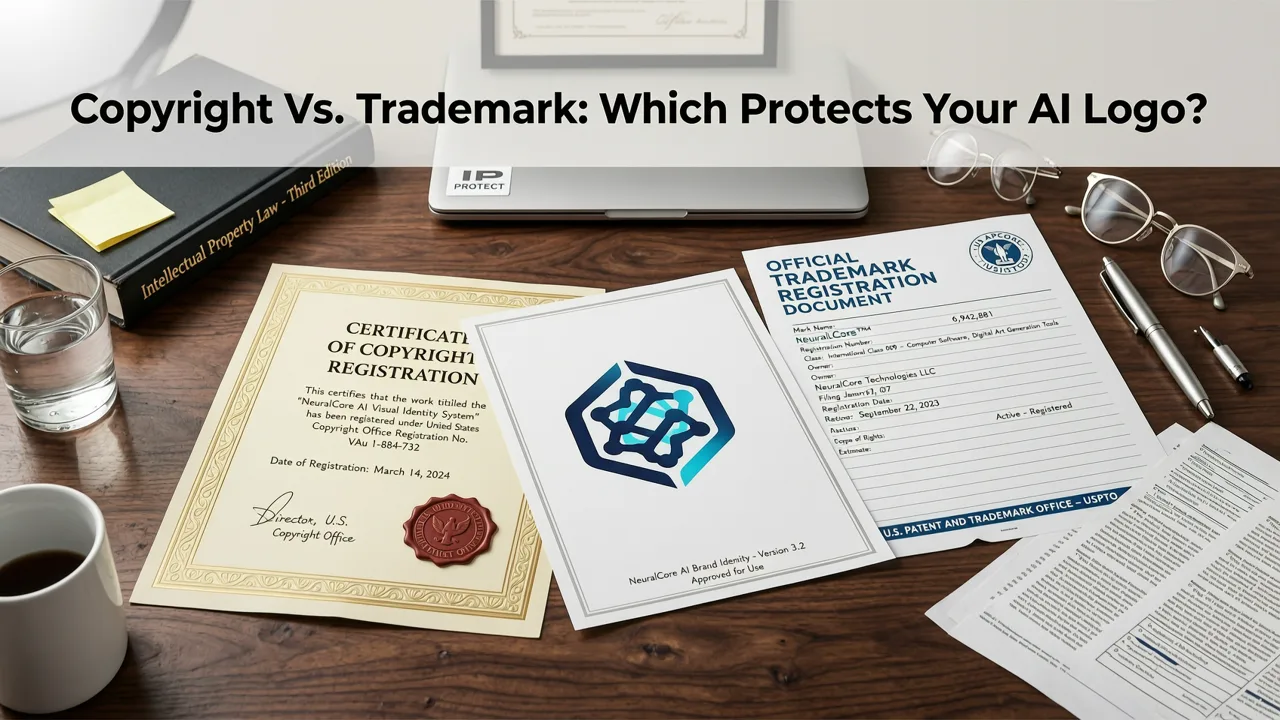
A common misconception among small business owners is that copyright and trademark are interchangeable. They serve entirely different legal functions, and understanding the difference is vital when dealing with AI-generated assets.
Copyright Protects the Art
Copyright protects original works of authorship fixed in a tangible medium. It prevents others from copying, distributing, or creating derivative works based on your specific artistic design. As established, purely AI-generated logos struggle to meet the human authorship threshold for copyright registration.
Trademark Protects the Brand Identifier
Trademark law, on the other hand, protects words, names, symbols, or designs used in commerce to identify the source of goods or services. The focus of trademark law is on consumer confusion, not on who authored the artwork. You can absolutely register a trademark for an AI-generated logo, provided it is being used in commerce to identify your brand and does not infringe on existing trademarks. The US Patent and Trademark Office does not currently require proof of human authorship for trademark registration, only proof of commercial use and distinctiveness.
How to Legally Protect Your AI-Generated Logo
If you want the full spectrum of intellectual property protection—both copyright and trademark—you must bridge the gap between automated generation and human authorship. Here is a strategic workflow to ensure your logo is legally defensible.
- Generate the Core Concept: Use an AI platform to establish the foundational visual direction, color theory, and iconography. When you create logo with ai, treat the output as a highly advanced mood board or starting point rather than a final, legally binding asset.
- Introduce Human Typography: AI often struggles with precise typographic layout. Manually selecting, kerning, and arranging your brand name using licensed or open-source typefaces adds a significant layer of human authorship.
- Vectorize and Refine: Export the AI raster image and rebuild it in vector software like Illustrator or Affinity Designer. Manually redrawing the paths, adjusting anchor points, and refining the geometry constitutes substantial human creative input.
- Composite Original Elements: Combine the AI-generated icon with manually created geometric shapes, custom illustrations, or unique background patterns to create a derivative work that is predominantly human-authored.
Platform Terms of Service vs. Intellectual Property Law
It is crucial to separate statutory intellectual property law from contractual platform terms. Even if an AI-generated logo is in the public domain under copyright law, the Terms of Service of the AI generator dictate your commercial rights to use the image.
Commercial Rights and Exclusivity
Most reputable AI design tools grant users full commercial rights to the outputs they generate. This means you can legally use the logo on your website, packaging, and marketing materials, and you can sell products bearing the logo. However, "commercial rights" do not equal "copyright ownership." The platform may grant you the right to use the image, but they cannot grant you a copyright they do not possess.
Reviewing Generative AI Guidelines
Always review the specific legal documentation of the tools you use. Major AI developers outline their stance on user rights and intellectual property in their official documentation. For instance, reviewing the OpenAI documentation or the Google AI guidance on responsibility and IP will clarify exactly what rights are transferred to the user upon generation. Ensure your chosen platform explicitly assigns commercial usage rights to you without requiring complex attribution.
Global Perspectives on AI Logo Copyright in 2026
Intellectual property law is not uniform across the globe. If your business operates internationally, you must consider how different jurisdictions treat AI-generated works. The following table outlines the general 2026 landscape for AI copyright across major markets.
| Jurisdiction | Stance on AI-Generated Copyright | Key Requirement for Protection |
|---|---|---|
| United States | No copyright for purely AI-generated works. | Significant human authorship and creative control. |
| United Kingdom | Recognizes "computer-generated works" without a human author. | Protection lasts 50 years from creation; author is the person who made the arrangements. |
| European Union | Generally requires human intellectual creation. | Originality reflecting the author's personality; pure AI lacks this. |
| Australia | No copyright for AI-generated material. | Requires independent intellectual effort by a human. |
As shown in the table, the UK stands out by offering a specific, albeit limited, copyright term for computer-generated works. However, for global brands, relying on the stricter US and EU standards—by ensuring human modification—is the safest legal strategy.
Practical Steps for Small Businesses and Ecommerce Brands
For founders and small business owners, the legal nuances of AI copyright should not deter you from using generative tools. Instead, it should inform your workflow. The goal is to leverage AI for speed and ideation while maintaining enough human oversight to secure your brand assets.
Building a Defensible Brand Identity
If you are building an online store, your visual identity is a primary conversion driver. When utilizing an ecommerce logo generator, focus on creating a unique combination of elements. An AI can generate a brilliant icon, but pairing it with a custom, manually-kerned wordmark and a specific, proprietary color hex code creates a composite brand identity that is much easier to defend and trademark.
Documenting Your Creative Process
If you ever need to prove human authorship to a copyright office or in a legal dispute, documentation is your best asset. Keep records of your prompts, but more importantly, keep records of your manual edits. Save the layered vector files, the typography selection logs, and the color palette adjustments. This paper trail demonstrates the independent intellectual effort required to transform a raw AI output into a protectable work.
Scaling Without Legal Risk
Ultimately, effective logo design for small business in 2026 is about balancing efficiency with legal prudence. You do not need to hire an expensive design agency to get a professional result, but you do need to take the final steps to own your work. By treating AI as a collaborator rather than a sole creator, you ensure that your brand identity remains exclusively yours.
Navigating Trademark Infringement Risks
While copyright focuses on authorship, trademark focuses on similarity. Even if you own the rights to your AI-generated logo, you can still face legal action if the AI inadvertently generated a design that is confusingly similar to an existing registered trademark.
AI models are trained on vast datasets of existing logos and artwork. There is always a risk that the model could reproduce elements of a protected brand. Before finalizing your logo and investing in marketing materials, conduct a thorough trademark search. Use the USPTO database or consult with a trademark attorney to ensure your AI-generated design does not infringe on existing brand identities in your specific industry class.
Conclusion
The copyright free ai logo rules of 2026 are clear: pure automation does not equal ownership. However, by understanding the distinction between copyright and trademark, and by intentionally adding human creative input to your AI-generated concepts, you can build a robust, legally defensible brand identity. Generative AI is a powerful tool for accelerating your launch, but the final layer of human refinement is what transforms a generated image into a protected business asset.
Ready to build a brand-ready logo that balances AI efficiency with professional quality? Explore our platform to generate, customize, and refine your visual identity today, ensuring your brand stands out legally and creatively in a crowded market.
Make your logo with AI Logo Generator
Describe your business or upload the logo you have, then edit the design and download it as PNG, SVG or PDF.
You can try it for free: new accounts get free credits to create logos. Logos you download without a plan have a watermark, and buying a plan removes it.
Next steps
Create a logo with AI Logo Generator, or redesign a logo you already have. Before you download it, check which logo sizes you need for the web, social media and print, and see how the main types of logo differ. Questions? Contact our support team.
More on logo design guides

2026-11-03
Free AI Logo Maker Tutorial: 2026 Step-by-Step Guide
Follow this free ai logo maker tutorial to design a professional brand identity in minutes. Learn the 2026 step-by-step process for founders.

2026-10-31
The Best Free AI Logo Generator for 2026: Ultimate Guide
Looking for the best free ai logo generator in 2026? Discover how modern AI tools create custom, scalable, and watermark-free logos for your brand in minutes.

2026-10-27
How to Make a Logo with AI in 2026: A Complete Guide
Learn how to make a logo with AI in 2026. Discover the exact process to create professional, scalable brand identities in minutes without design skills.