
2026-08-21 · 9 min read
Small Business Logo Stickers: The 2026 Guide to Custom, Affordable
Small business logo stickers are a low-cost, high-impact branding tool in 2026. Learn how to design, print, and deploy custom logo stickers that drive awareness and

Recommended next
Small Business Logo Stickers — What They Are and Why They Still Matter in 2026
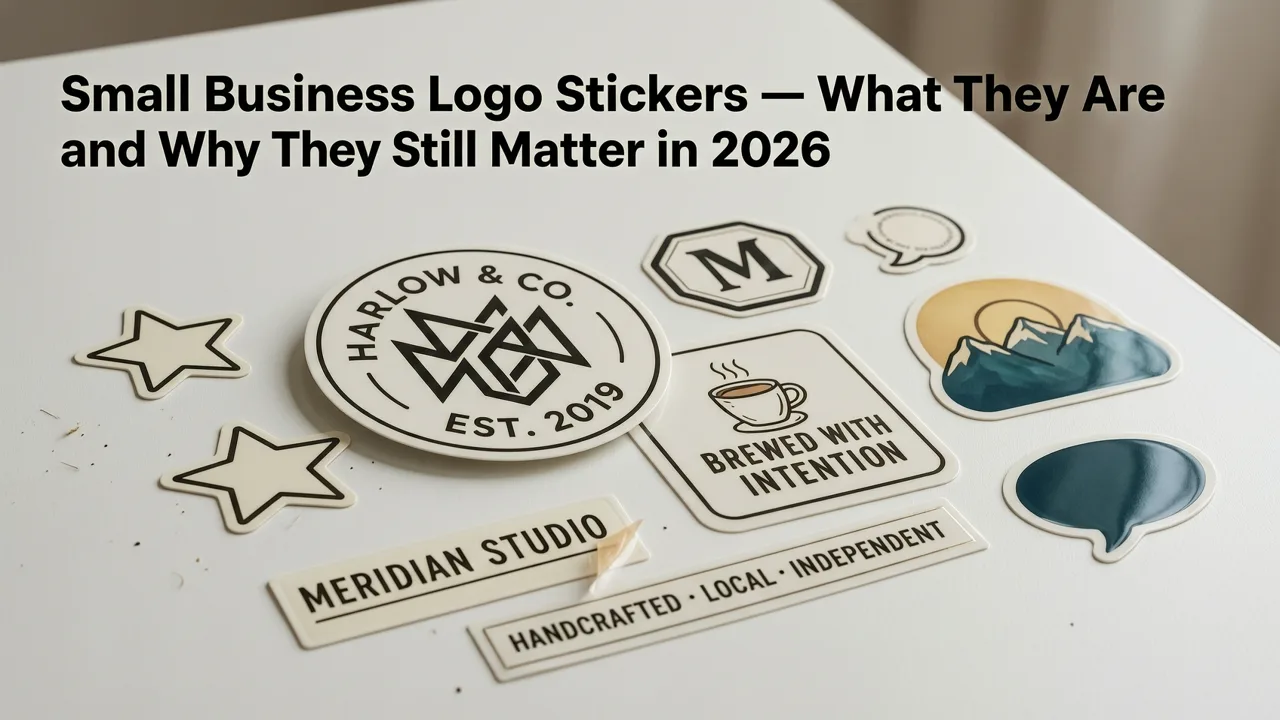
Small business logo stickers are one of the most cost-effective branding tools available to founders, creators, and ecommerce operators in 2026. A well-designed sticker travels on laptops, water bottles, packaging, and storefront windows — turning everyday surfaces into portable brand impressions. The best part? You no longer need a graphic designer or a large print budget to produce professional, print-ready logo stickers.
If you run a small business, the question is no longer whether you should use branded stickers — it is how to design them correctly so they look sharp in die-cut, kiss-cut, and holographic formats. This guide walks you through everything: choosing the right style, preparing files for print, selecting materials, and deploying stickers across your customer journey.
Why Small Business Logo Stickers Are a High-ROI Branding Asset
Stickers deliver compounding visibility. Every time a customer places your branded sticker on a laptop or water bottle, you earn a passive impression — often in a social or professional setting where word-of-mouth begins. Industry estimates suggest a single well-placed sticker can generate hundreds of impressions over its lifetime, at a per-unit cost that often falls below fifty cents.
For small businesses operating on tight margins, that economics is hard to beat. Here is how logo stickers compare to other common branding investments:
| Branding Asset | Average Cost per Unit | Typical Impressions | Shelf Life |
|---|---|---|---|
| Small business logo stickers | $0.15 – $0.75 | 200 – 500+ | 1 – 3 years outdoors |
| Branded business cards | $0.08 – $0.25 | 5 – 15 | Weeks to months |
| Custom packaging tape | $0.10 – $0.40 per inch | 1 – 3 (per shipment) | Single use |
| Promotional t-shirts | $8 – $20 | 50 – 150 | 1 – 2 years |
The takeaway is clear: stickers punch far above their price class. When paired with a strong visual identity, they become a self-sustaining marketing channel.
How to Design Small Business Logo Stickers That Actually Look Professional
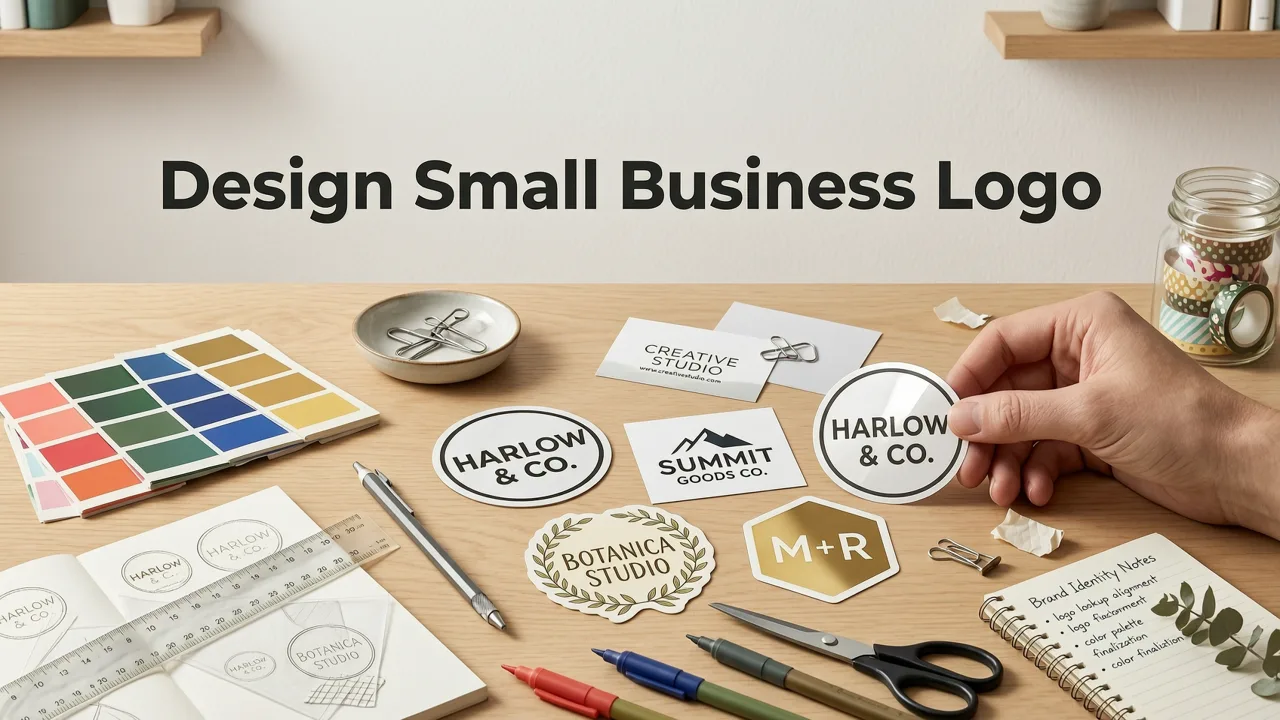
A sticker is a miniature billboard. Because it is small — typically between two and four inches — every design decision matters more than it would on a website or a business card. Here are the principles that separate polished stickers from amateur-looking ones.
1. Simplify Your Logo for Sticker Scale
If your full logo includes a long tagline or intricate illustration, you will likely need a simplified lockup for sticker use. Think icon plus short wordmark, or icon only. Test your design at actual print size — if the text is unreadable at two inches, simplify further.
2. Use High-Contrast Color Pairings
Stickers are viewed in motion, often from a distance. Bold contrast — dark logo on a light background, or a vibrant accent color against white — ensures your brand reads instantly. Avoid subtle gradients that flatten when printed on vinyl.
3. Design for Your Cut Style
The two most common sticker formats are die-cut (cut to the exact shape of your design) and kiss-cut (cut through the sticker layer but not the backing paper, leaving a border). Die-cut looks premium; kiss-cut is more forgiving for complex shapes and multi-sticker sheets.
4. Export in Vector or High-Resolution Raster
Print shops and online sticker services require clean files. A vector PDF or SVG is ideal. If you are working with raster files, export at a minimum of 300 DPI at the final print size. Blurry edges are the fastest way to make a sticker look cheap.
Modern AI-powered tools have made this process dramatically faster. With an AI logo sticker maker, you can input your brand name, choose a style, and receive print-ready sticker concepts in minutes — no design software required.
Choosing the Right Material and Finish for Your Stickers
Material selection determines how your stickers look, how long they last, and where they can be applied. Here is a breakdown of the most popular options in 2026.
- White vinyl: The default choice for outdoor durability. Waterproof, UV-resistant, and available in matte or gloss finishes. Best for laptop stickers, bumper stickers, and product packaging.
- Clear vinyl: Ideal for a "no-label" look on glass, product jars, or transparent packaging. The design floats on the surface.
- Holographic vinyl: Adds a premium, eye-catching shimmer. Popular with DTC brands, artists, and lifestyle companies targeting younger audiences.
- Kraft paper: Gives a handmade, artisanal feel. Best for indoor use — think packaging seals, notebook giveaways, and craft-fair branding.
- Reflective vinyl: Bounces light for high visibility. Used for safety branding, cycling communities, and nighttime events.
When selecting a finish, consider your brand personality. Gloss reads bold and modern. Matte reads refined and understated. Holographic reads playful and premium. Match the finish to the emotion you want your brand to evoke.
Where to Deploy Small Business Logo Stickers for Maximum Impact
Designing great stickers is only half the equation. Deployment strategy determines whether they generate brand awareness or end up in a drawer. Here are the highest-impact use cases for small businesses.
Product Packaging and Shipping
A branded sticker on a shipping box or product bag turns a routine unboxing into a brand moment. It also seals packages securely while reinforcing your visual identity. Many ecommerce brands use a simple logo sticker as a tamper-evident seal — functional and promotional at once.
Customer Giveaways and Insert Cards
Include two or three stickers with every order. Customers who apply them to personal items become voluntary brand ambassadors. This tactic works especially well for subscription boxes, Etsy shops, and DTC brands.
Local Partnerships and Community Events
Hand out stickers at farmers markets, pop-up shops, co-working spaces, and local meetups. Stickers are low-friction giveaways — people accept them readily, and they travel far beyond the event itself.
Employee and Team Branding
Equip your team with branded laptop stickers. When employees work from coffee shops, conferences, or co-working spaces, your logo earns impressions in professional environments where potential customers are present.
Complementary Branding Assets
Stickers are part of a broader physical branding toolkit. Consider pairing them with other custom assets — for example, a baseball cap logo generator can help you produce branded headwear that complements your sticker giveaways at events and trade shows.
How to Order Small Business Logo Stickers in 2026
The ordering process has become remarkably streamlined. Here is a step-by-step workflow that works whether you are ordering fifty stickers or fifty thousand.
- Finalize your sticker-ready logo. Use an AI tool or work with a designer to create a simplified, high-contrast logo lockup optimized for small-scale printing.
- Choose your size and shape. Common sizes range from 2×2 inches to 4×4 inches. Die-cut shapes follow your design outline; kiss-cut sheets are ideal for variety packs.
- Select material and finish. White glossy vinyl is the safest starting point. Upgrade to holographic or reflective once you know what resonates with your audience.
- Upload your file and proof. Most online printers provide a digital proof before production. Check alignment, color accuracy, and bleed lines carefully.
- Place your order and track delivery. Turnaround times in 2026 typically range from three to seven business days, with rush options available.
Platforms like Sticker Mule, StickerApp, and Moo remain popular choices. Many AI logo generators now integrate directly with sticker printing services, allowing you to go from concept to order in a single session.
Common Mistakes That Make Small Business Logo Stickers Look Amateur
Even well-intentioned founders make avoidable errors when producing their first batch of stickers. Watch out for these pitfalls.
- Using a low-resolution image. A pixelated logo looks unprofessional at any size. Always start with vector files or 300 DPI raster artwork.
- Ignoring bleed and safe zones.Printers require a bleed area — typically 1/8 inch beyond the cut line. Keep critical design elements inside the safe zone to avoid accidental trimming.
- Overloading the design. Stickers are small. If your sticker includes a logo, tagline, website, phone number, and social handle, it will be unreadable. Stick to one or two elements.
- Choosing the wrong material for the use case. Paper stickers peel and fade outdoors. If your stickers will live on water bottles or car windows, vinyl is non-negotiable.
- Skipping the proof. Colors on screen rarely match printed output exactly. Always review the printer's digital proof before approving production.
Measuring the Impact of Your Sticker Campaign
Stickers are difficult to track with traditional analytics, but that does not mean their impact is unmeasurable. Here are practical ways to gauge ROI.
Social Media Mentions and Tags
Encourage customers to share photos of their stickered items on social media with a branded hashtag. User-generated content featuring your sticker is both social proof and free advertising.
Sticker-Specific Promo Codes
Print a small promo code on your sticker sheet — for example, "STICKER10" for ten percent off. Customers who use the code reveal themselves as engaged brand fans, and you gain a direct attribution channel.
Customer Surveys
Include a brief question in post-purchase surveys: "Did you receive our branded stickers?" Track responses alongside repeat purchase rates to identify whether sticker recipients show higher lifetime value.
Small Business Logo Stickers vs. Other Physical Branding Tools
Stickers are powerful, but they are not the only option. Understanding where they fit in your broader branding strategy helps you allocate budget wisely.
| Branding Tool | Best Use Case | Cost Range | Durability |
|---|---|---|---|
| Logo stickers | Giveaways, packaging, community events | $0.15 – $0.75 each | 1 – 3 years |
| Logo stamps | Handmade product authentication, packaging seals | $25 – $80 one-time | Indefinite (with re-inking) |
| Branded apparel | Team uniforms, event merch | $10 – $30 each | 1 – 3 years |
| Custom packaging | Unboxing experience, premium positioning | $0.50 – $3.00 per unit | Single use |
For businesses that ship physical products, consider combining stickers with a logo for stamp design to authenticate handmade goods, or an AI logo stamp generator for custom wax-style seals on premium packaging.
Final Thoughts: Start Small, Iterate, and Scale
Small business logo stickers are a deceptively powerful branding tool. They are inexpensive to produce, easy to distribute, and capable of generating compounding impressions over months or years. The key is to invest in clean design, choose the right material for your use case, and deploy stickers strategically across every customer touchpoint.
Start with a small batch. Test two or three designs. See which ones your customers actually apply to their belongings. Then double down on what works. In 2026, the brands that win are the ones that turn every surface — a laptop, a water bottle, a shipping box — into a quiet ambassador for their identity.
Ready to create your first batch? Use an AI-powered logo tool to generate a sticker-ready design in minutes, then send it straight to print. Your brand deserves to be seen — and a sticker is the cheapest, most effective way to make that happen.
Related resources
Next steps
Start on the homepage, or jump to the main CTA via contact. You can also explore localized pages like United Kingdom or Germany.
Related blogs

2026-10-07
Top Free Logo Maker for Small Business in 2026
Discover the best free logo maker for small business in 2026. Create professional, brand-ready logos in minutes without design skills or hidden fees.

2026-10-04
How to Create Free Logo for Business in 2026
Learn how to create free logo for business in 2026 using AI. Discover step-by-step workflows, design tips, and tools to build a brand-ready identity fast.

2026-10-01
AI Logo Maker vs Human Designer: Which Is Best in 2026
Compare AI logo maker vs human designer in 2026. Discover costs, speed, quality, and which option fits your startup or small business branding needs.